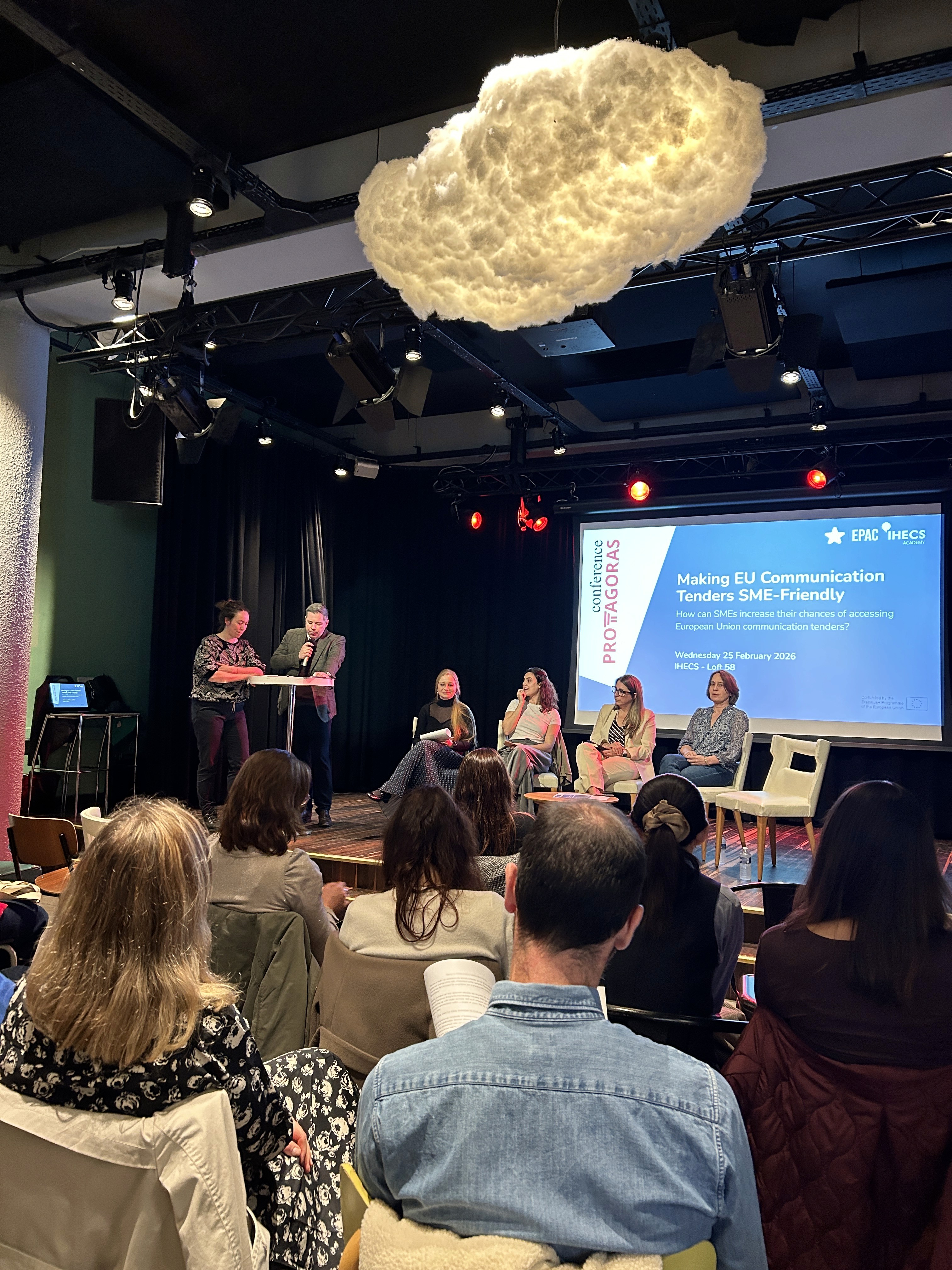
A few weeks ago I attended a professional event that surprised me. And let me start from there: it felt good.
It felt good because for once I was surrounded by people who do what I do : bid managers, creatives, entrepreneurs, even people from the Commission side. All of us usually working behind the scenes, alone behind a laptop, invisible to most. And suddenly, there we were, in the same room, talking openly about the same things. That almost never happens in this line of work. Being there with a dear friend and colleague, Chiara Ceccarelli, made it even better.
It happened at IHECS Academy in Brussels for the presentation of Making EU Communication Tenders SME-Friendly, a research report by the Protagoras think tank, produced as part of a Jean Monnet Module. Interviews, policy analysis, a panel with people who actually live this every day. I expected it to be interesting. I didn't expect to feel so connected. But there was something in the air that day, a rare kind of honesty, that made strangers (or even "frenemies" eventually) feel like allies within minutes.
The entrepreneurs trying to break into the big game? They felt seen. The bid managers burning with ambition? Seen. The creatives who just want their ideas to breathe? Seen.
Because here's the thing: bids are the only real way to do communications for institutions and reach the most people. If you want to give voice to EU campaigns that cross borders, that actually land with citizens, you go through tenders. That's the door.
And once you're in, there's this incredible rush, this adrenaline of pulling strategy and creativity together under impossible deadlines, that keeps you coming back. Just like with bids and their own methodologies. But it can be lonely. So being together like that, even for a few hours, meant something.
A word about the people behind this. Nicolas Baygert (Director of Protagoras), and Laura Leprêtre opened the stage, setting the tone for a conversation that felt both rigorous and human.
On the panel, alongside Gokcecicek Kalayci (founder of Seven of Nine, previously Director at Tipik and ICF) and Gaelle Pellon (Director of New Business at VO), we also heard from Brigitta Bod and Paula Antón Vergara, EPAC alumni who co-authored the research. The report itself was conducted by a group of seven students as part of the EPAC programme, and honestly, the quality of the work is impressive. It's one thing for practitioners to question about tenders over coffee. It's another to see those thoughts articulated with academic rigour, backed by interviews, data, and policy analysis. That's what makes this report different.
Gokcecicek spoke exactly about that: the power of ideas, and how procurement processes, with all their layers of bureaucracy and technicalities, end up smothering them before they ever see the light. Hearing someone name that out loud, in a room full of people who live it, felt good. Gaelle, whom I know from my time at in the agency back in 2022, brought the view from a larger SME, and made a point that stayed with me long after I left: even when your company grows, the system doesn't grow with you. You just hit bigger walls.
Now, the report itself. It's rigorous, it's well-researched, and it puts words on things that anyone in this field has felt in their bones for years but rarely gets to say out loud.
The administrative burden is overwhelming. SMEs spend 30 to 50 working days preparing a single tender, with zero guarantee of winning. The paperwork is repetitive, the formatting rules are ruthless (one wrong margin and you're disqualified), and instruments like the European Single Procurement Document haven't simplified much in practice.
One interviewee remembered winning their first EU contract with a single-page fax. Today you need 150 pages (let that sink in). Yes, indeed there can be a middle ground.
Large consortia run the show. Tenders have become so massive (some over tens of million euros) that small agencies either can't get in at all or end up with token roles inside consortia led by the big players. Framework agreements lock the supplier list for years. If you weren't there from the start, good luck.
And then there's the money problem. Only 30% of a contract's value is paid upfront. The rest? You finance it yourself. Several professionals in the report called this "economically dangerous". Meanwhile, the EU keeps asking for creativity and innovation, but the system rewards those who play it safe and follow the template to the letter.
Here's what gives me hope though: the report doesn't just point fingers. It proposes things. A centralised platform to store and reuse documentation. Smaller, SME-friendly tenders alongside the big frameworks. Smarter scheduling across Directorates-general (seriously, no more deadlines on 24 December). And more dynamic purchasing systems, which unlike framework agreements, actually let new players in. The conversation is only just beginning.
Because if the EU wants the creativity and diversity it keeps talking about, it needs to make space for the people who bring it.
We're here. We've always been here. We just need the door to open a little wider.
The full report is available on the Protagoras website.
Ciao!