
On the professional side, this week four things landed on my radar almost simultaneously, and they are making me think. A video of a developer basically talking about building her own replacement software. An essay by Jack Dorsey, co-founder of Twitter and CEO of Block, on why organisational hierarchy is structurally obsolete. A policy document by Sam Altman, CEO of OpenAI, in which he publicly acknowledges the scale of what is coming. And a talk by Jenny Wen, head of design at Anthropic, on why the creative process as we know it is basically dead.
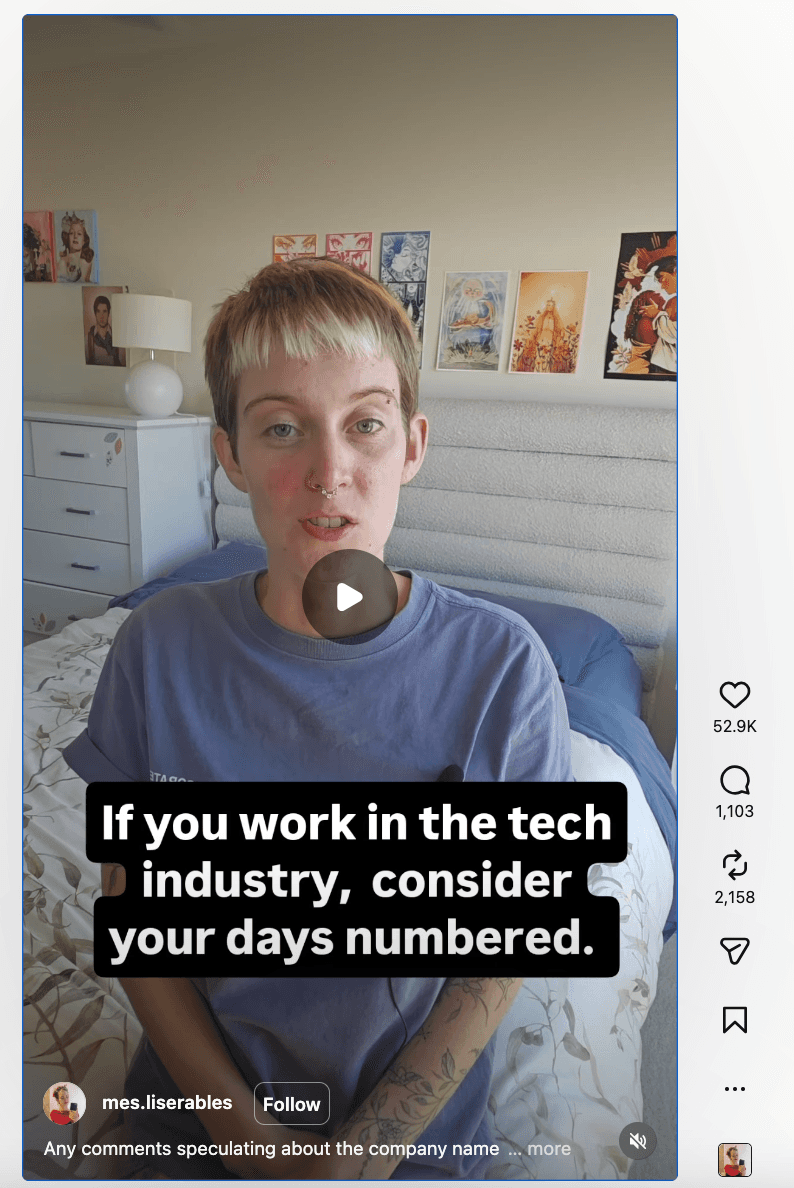
Full reel by IG account mes.liserables here
I recognised something in all of it. A few years ago I was made redundant, on Workers' Day, at the beginning of the Covid pandemic. It was uncomfortable, bumpy, and at times genuinely frightening. It also pushed me to go out of the comfort zone, toward entrepreneurship, toward skills I would never have built inside the safety of a stable role, and eventually toward a more skilled and experienced version of myself. That experience does not make me immune to the unease of this current time. But it does make me want to meet it with as much curiosity as I can, because I have seen what discomfort can open up when you go through it rather than around it.
That is what this article is. Not an alarm, and not a reassurance. An attempt to think through, together, what this moment is actually asking of us, and what it might make possible, especially for those of us working in communications, bids, and European institutional campaigns.
When profitable companies start cutting
In late February, Jack Dorsey announced that Block, the fintech company behind Square and Cash App, was cutting 40% of its workforce. Four thousand people. The detail that stopped many people in their tracks was not the number itself but the context: the business was profitable and growing, with gross profit up 24% year on year. Dorsey was explicit that this was not a distress decision.
Critics were equally quick to point out that Block had more than doubled its headcount during Covid, growing from roughly 3,800 to over 10,000 people, and that unwinding an overhiring binge looks rather different from a pure AI efficiency story. Dorsey acknowledged the overhiring partially, but disputed it as the primary driver. Both things can be true simultaneously, and that tension is worth keeping in mind as we read what came next.
A few weeks after the layoffs, Dorsey and Roelof Botha, managing partner at Sequoia Capital, published a long essay called From Hierarchy to Intelligence, which laid out the intellectual architecture behind the decision. It is worth reading. The argument, in short, is that organisational hierarchy has never been sacred. It was always a workaround. From the Roman army's contubernium to the McKinsey matrix, two thousand years of management thinking has essentially been solving the same problem: how do you route information and coordinate decisions across large groups of people when humans are the only available mechanism for doing so? The answer was always layers. Layers of command, layers of management, layers of alignment. Not because layers are inherently good, but because there was no alternative.
Dorsey and Botha argue that AI is now that alternative. For the first time, a system can maintain a continuously updated model of an entire business and use it to coordinate work in ways that previously required humans relaying information through chains of command.
Middle management, in this framing, was never really about the people. It was about the information. And now the information has somewhere else to go.
This is a serious argument and it deserves serious engagement.
But here is what I cannot let pass without saying. The essay was published on 31 March. The layoffs were announced on 26 February. The philosophy arrived five weeks after the decision. And for all its intellectual sweep, from Roman legions to Prussian military reform to Frederick Taylor, the essay devotes roughly one paragraph to the 4,000 people who lost their jobs. Beautiful historical framing and a brutal workforce restructuring are not the same thing, and we should be honest about the risk of letting one quietly justify the other. The mortgages are still real. The career disruptions are still real. Layoffs dressed in the language of civilisational inevitability are still layoffs.
Then, in April, Sam Altman and OpenAI published a document titled Industrial Policy for the Intelligence Age, which opens by acknowledging, in plain language, that AI will disrupt jobs and entire industries at a speed and scale unlike any previous technological shift, that wealth risks becoming concentrated in a small number of firms, and that markets alone will not manage this transition.
They call for new industrial policy, portable benefits, shorter working weeks of 4 days, robot tax, public wealth funds. For a Silicon Valley company to produce this document is genuinely noteworthy. These are not the usual talking points.
And yet. The document is also, if we are being clear-eyed, a masterclass in narrative management. OpenAI is under significant regulatory and political pressure. Publishing a document that says "we see the risks, we want to keep people first, here are our ideas for policy" is also a way of shaping the regulatory conversation before regulators shape it for you. The document focuses almost entirely on the United States. It mentions the EU AI Act once, in passing. For a piece about global AI governance written in April 2026, that is a conspicuous gap, and one that those of us working in European institutional communications will notice immediately.
None of this makes the ideas wrong per se. Some of them are worth thinking upon. But intellectual honesty requires us to read these documents as both arguments and especially strategic communications, because that is what they are. And communications people, of all people, should be able to hold that duality without discomfort.
What is the impact on creative processes?
What makes this moment genuinely different from previous disruptions is not just that jobs are disappearing. It is that the reasons certain jobs and methodologies existed are disappearing. That distinction matters enormously.
Jenny Wen, head of design for Claude at Anthropic and formerly Director of Design at Figma, made this point recently in a talk that has been circulating widely. Her argument was direct:
the design process that designers have been taught to treat as gospel is basically dead. Not because design does not matter. Because the constraint that shaped the process no longer exists.
The classic design workflow, discovery, diverge, converge, prototype, hand off, was built around a simple reality: execution was slow. If building something took months, you needed to be very sure you were building the right thing before you started. So you spent weeks on research, personas, journey maps, problem statements. The process was rational given the constraint.
Now an engineer can run several AI agents simultaneously and ship a working version before a designer has finished the persona deck. The constraint is gone. So the process built around it becomes, at best, inefficient, and at worst, an obstacle to the actual work.
What replaces it, Wen argues, is craft, judgment, and taste. The ability to look at something half-built and know whether it is going in the right direction. The ability to spot an idea that nobody can quite articulate yet but that has unmistakable energy, and translate it into something coherent and useful. These are not process skills. They are deeply human ones, and they have always been the thing underneath the methodology.
There is something else in her argument worth sitting with. AI has made everyone a creator. The barrier to producing, a deck, a draft, a prototype, a brief, has collapsed.
Which means the differentiator is no longer whether you can make something. It is whether you know what is worth making, and why. That is a profound shift, and for people with genuine creative instinct, it is also a wide-open door.
To be honest, her point is very uncomfortable to me, not because I'm afraid of creating things of learning (who knows me know that I'm far from being like that) but because all my life I've approached things valuing methodologies like design thinking, PM techniques etc. starting from the people, connecting with emotions in a way that now is apparently changing.
Now it is our turn
Neither Dorsey nor Wen nor Altman is speaking to communications strategists or bid managers, especially for the EU comms related ones. So let us do that ourselves.
The production layer of communications is compressible. First drafts, research summaries, content frameworks, early creative concepts: AI handles these fast and adequately (under our supervision). Anyone whose value proposition rests primarily on that layer is in a more fragile position than they might currently feel. This is not said to frighten. It is said as an honest mirror, starting with myself, because the people who will navigate this best are the ones who look clearly at where their real value lives, rather than where they have been comfortable assuming it lives.
Many people in this field have leaned on process as the legible, billable surface of the work. The methodology slide. The twelve-step brief template. The framework that signals rigour to a client who is not entirely sure what they are buying. That surface was maybe never where the real value lived.
Maybe it was a translation layer between genuine strategic thinking and institutional comfort. Now that the surface is replicable, the question worth asking is: what is underneath it, for us, specifically?
In the European institutional communications sector, this question is particularly pointed. Tender culture has long rewarded process description over actual thinking. Evaluation grids that score methodology sections incentivise a particular kind of performance, one where you demonstrate that you have a system, that you follow steps, that nothing will be left to chance or instinct. The result is a sector that has become extraordinarily good at describing how it works, and sometimes despite the best intentions and dedication, less attentive to whether the work actually moves people, changes minds, or serves the citizens it is meant to reach (I plead guilty here, myself included).
AI will not fix the tender system. That is a structural problem that requires political will and a very different conversation. But it will expose the difference between practitioners whose value is genuinely irreplaceable and those who have been, perhaps without fully realising it, selling process as a proxy for thinking. And in that exposure, there is also an enormous opportunity. Because the sector needs better campaigns, smarter narratives, more honest audience understanding. AI can help us get there faster, if we bring the judgment to steer it.
What does not compress: understanding how institutions actually make decisions. Knowing which narrative will survive contact with a particular audience. Reading the political temperature of a room. Building trust over years, losing it in a moment, knowing how to rebuild it. The strategic judgment that comes from having been wrong before and learned something specific and painful from it.
And then there is something this sector has not been good enough at naming, let alone valuing. Creative instinct. The capacity to look at a communication challenge and feel, before you can fully articulate it (that Jenny Wen talks about), what shape the answer needs to take. In bids and institutional comms, this quality has often been treated as a liability, something to be managed, translated into safer language, made to sound more like a system so the evaluation committee does not get nervous. The person with the creative eye has frequently been asked, implicitly or explicitly, to become someone more legible before the proposal goes out.
This is the moment to stop doing that. Not as an act of sentiment, but as a strategic choice. If AI makes everyone a producer, the person with genuine creative judgment is not a risk. They are the differentiator. The thing you cannot prompt your way to. The EU comms sector, at its best, has always needed more of that energy, not less. Now it finally has a reason to say so out loud.
What disruption can open
The Covid disruption taught many of us something that did not make it onto the motivational posters. Navigating a moment of structural change happens in the uncomfortable in-between, when the old thing has stopped working and the new thing is not yet clear. What we do there is what matters.
The path is rarely smooth. It is bumpy and imperfect and humbling.
There were moments, in that period, where the disorientation felt permanent. But it moved. And for many of us, that forced reinvention led somewhere they we'd never reached by staying comfortable. New skills, new collaborators, a broader and more honest understanding of what they were actually capable of.
The agentic AI wave is not coming. It is here. We get it. The US engineers on Instagram are not early warnings. They are the present tense. And the question for those of us in EU comms and bids is not whether to engage with this shift, but how. Do we engage on our own terms, with our judgment intact and our curiosity genuinely alive? Or do we wait until the options are narrower?
I am not suggesting anyone perform enthusiasm for tools they do not yet understand and that can be sometimes frightening. What I am suggesting is that this moment, uncomfortable as it is, carries real possibility. For better campaigns. For more honest institutional communication. For the creative people in this sector to finally be seen as assets rather than liabilities. For all of us to go deeper into what we actually know, rather than hiding behind what we can describe.
The floor has always been moving. The difference now is that we can see it clearly enough to decide how we want to move with it.
Ciao!